Table of Contents
How much does it cost to live in Argentina?
The cost of living in Argentina can vary widely depending on your lifestyle and the state of Argentina’s volatile economy.
A reasonable minimum for a single person who plans to rent a basic room in a shared house would now be around $900 per month.
Buskers, squatters and those who really live on the edge could get away with a less.
By comparison, the average Argentine’s salary is between $400-$500 a month.
Those used to a relatively comfortable life that includes eating out, taking taxis and weekend trips will probably want to budget for at least US$1,000 per month in Buenos Aires, and less in most of the rest of the country. .
Some foreigners may argue that should be a bit more if you want to live an average ‘expat’ lifestyle: taking a few classes, having private health insurance, going to museums and movies, eating out a couple of times a week, taking vacations and to have some extra cash on hand in case of an emergency.

A family of four planning on installing themselves in a major city will be fine with US$1,800 per month for smaller cities and US$2,000 for Buenos Aires.
A significant amount more will be needed for those planning to send the kiddos to one of the elite private schools such as Lincoln American school, which costs US$15-30k a year, depending on the child’s age.
Foreigners who live in Argentina diverge greatly in how much they spend month to month. The big gap has to do with whether one earns pesos or a foreign currency and whether one lives an ‘Argentine lifestyle’ or not.
Purchasing imported products and frequent travel within the country will greatly increase expenditure.
Sometimes it seems there are two economies — one for foreigners from developed countries and one for South Americans.
Speaking Spanish certainly gives you an edge in obtaining goods and services at a local price as opposed to a ‘tourist price.’
High-quality prepared food, clothing and electronics are expensive in Argentina. If you don’t need many luxuries, you can live on much less than any major city in Europe, Australia or the U.S. Those who want to enjoy some of the comforts of home, including pricey imported items such as Apple products, exotic foods and brand name shoes, should budget for much more to live in Argentina or better yet, bring those products from home.
On the housing front, a single person should expect to pay at least US$350 per month on housing to rent a room in a shared house or apartment in a major city.
Those who want to rent their own furnished apartment will need considerably more and should prepare to spend around US$600-950 for a studio or one bedroom plus a deposit of equal value and other fees.
The ‘rentista visa,’ one of the most common used by foreigners who wish to live in Argentina, is awarded to those who can provide proof of a monthly investment income of AR$30,000 (approximately US$600 as of November 2019) per month.
The retirement visa has a similar income requirement, and the funds must be transferred to an Argentine bank every month.
If you plan to eat in the most fashionable restaurants every night, take weekend trips to Mendoza and Punte del Este, own a car (or always take cabs), get a little nip and tuck here and there and live in a beautiful classic building overlooking the city, could spend up to US$ 3,000-4,000 per month and enjoy it immensely.
Accessing Money in Argentina: Return of the Blue Dollar
(Argentina — never boring! Everything has changed. November 2019 update!)
During the administration of Cristina Fernandez de Kirchner of 2012-2015 Argentina got notoriety for its convoluted currency situation. The government seriously restricted the purchase of dollars for citizens to control capital flight.
The result was a huge black market for foreign currency (mostly U.S. dollars, Euros, and Brazilian Reals). The black market rate for dollars was euphemistically called the ‘Blue Dollar‘.
By going to technically illegal, but ubiquitous, underground currency exchange houses, called cuevas (caves), travelers with USD, Euros, Reals (and to a lesser extent GBP and CAD) could get up to 40% more pesos for their foreign currency.
Hapless tourists who would withdraw money from an ATM, as they would anywhere else, would complain about how expensive Argentina was to visit, not realizing that was because they were getting the terrible official exchange rate for their money.
It’s just proof that doing your research before traveling to Argentina has a big pay-off!
After elected in 2015, the administration of Mauricio Macri regularized the currency situation, so that the spread between the official foreign exchange rate and the ‘blue market’ rate became negligible so tourists no longer came to the country with wads of cash.
But renewed currency controls put in place as of September 2019, the Blue Dollar is back.
The election of a new president, Alberto Fernández in October 2019, with Cristina Kirchner returning as Vice President, meant currency controls were put in place once again, reviving Argentina’s lively parallel currency.
This means that visitors will lose more than half their money’s value withdrawing from an ATM bank machine in Argentina.
Today the spread between the official rate and black market rate for dollars is volatile and hovering around 100%.
It goes without saying that travelers should consider traveling to Argentina with cash in order to sell their hard currency and get a better rate.
If you bring cash you will be able to take advantage of the better exchange rates on the black market, help Argentines who are desperate for dollars, as well as save on exorbitant ATM fees.
(Relying on ATM machines poses an additional injury to your pocketbook because there are low daily limits on the amount one can withdrawal from a foreign bank account — usually around US$100. The ATM fees are steep as well — about 10% on the maximum withdrawal amount)
We have more about information about trading cash on the black market here.
• Can I make a living teaching English there?
A native English speaker without a strong regional accent can teach English in Argentina, even without certification (although having one helps, you can even get a TEFL certificate online).
Make a living? If it’s your only source of income you will be earning in the heavily devalued peso, so it is a bit of a challenge unless you stay a while and really work it.
Look at teaching English locally in person more as a short-term way to make a modest income — only the most dedicated people seem to have the wherewithal to make it a profession in Buenos Aires. In other areas of the country, such as Patagonia, Mendoza, or Cordoba, where costs are lower and there are less native English speakers, it is more viable as a full-time job.
Either way it’s certainly not like teaching English in China or South Korea, where you can actually save some decent money. Teaching English can be fun for the short-term but unless it’s your personal passion, you might want to consider finding something more profitable to do if you plan on staying here a while.
These days, many foreigners in Argentina are finding financial leverage by teaching English online via Skype. There is a huge market for native English speakers to teach Chinese children English online and the pay is about $15-20 per hour, which is a very good wage in Argentina. Now that the Blue dollar has returned, these online teachers are able to pay the bills teaching only teach a few classes a day.
See:
Teaching English in Argentina: Logistics of the Job,
Teaching in Argentina, Five Things to Consider Before Taking the Job,
How much do English teachers make in Argentina?
The Woes of Teaching Abroad in Argentina at Wander-Argentina.org.
• What about visas for Argentina?
We’ve outlined information about tourist visas here, but what happens if you want to stay in Argentina longer than six months? One option that many ‘perma-tourists’ (as those who don’t do the paperwork to get residency are referred to) choose is to take the boat ride over to Uruguay, usually Colonia, in order to get a new entrance stamp every three months.
Argentina is one of the world’s most lax countries on immigration laws. Many people just renew their tourist visa for years on end without a problem, but you never know — especially in Argentina.
Depending on the country’s political climate, a passport full of stamps in and out of the country throws up the red flags and in a rare cases, people caught doing this are ordered to get the ball rolling on their residency papers or leave the country.
The government very rarely cracks down on those who renew their tourists visas over and over again, although it depends on a few factors such as the number of renewals, the nationality of the violator and by all appearances, the mood of the immigration official. Anecdotal evidence leads us to believe that long-term ‘perma-tourists’ with non-EU passports are more vulnerable to being hassled.
Those who get sick of the day trips to Uruguay often choose to simply overstay their visa and pay the fine on the way out of the country. It is the most painless and cost effective option for those staying long-term (but you didn’t hear it from us.) There are those who are uncomfortable living as ‘illegal aliens,’ but we haven’t yet heard of any cases of people being forbidden to reenter the country for overstaying their visa. In fact, the government calls those who overstay their visa ‘irregular’ — having immigration irregularities is not a crime.
The penalty for overstaying a tourist visa for non-mercosur citizens is currently AR$11,00 pesos (approximately US$84 at the official rate or $37 at the blue rate) for under two years of overstay, paid on the way out.
Those who overstay more than two years get the fine doubled.
Those who overstay more than four years, or who are unable to prove when they entered the country, are fined AR$15,000.
Check Argentina’s immigration website to find out more about current fees to leave the country on an expired tourist visa.
If you chose the overstay route, you may get a bit of a lecture from the immigration officer when you pay your fine, but that’s about it. If you choose to leave without paying the fine for overstaying, you will most likely not be permitted into the country in the future.
There are variety of opinions about this topic among foreigners in Buenos Aires, but those who go to Uruguay every three months to renew their visas over a period of years are basically advertising that they’re bending the rules,
immigration officers for wondering why someone from a developed nation would do that for years on end without legalizing their status.
Certainly the thousands of Ukrainians, Colombians, Chinese and Africans who overstay their tourist visas in Argentina are not taking a boat to Uruguay every three months for a new stamp.
Although rare, it should be emphasized that in the last few years there have been reports of people being told they need to legalize or leave the country after repeated trips to Uruguay to renew their tourist visa.
After living in Argentina a while one learns that playing by the official rules and trying to do things ‘correctly’ doesn’t always work in one’s favor, however illogical.
That trait can be rather frustrating, or perhaps endearing, for those who wish to linger in Buenos Aires for years without paperwork headaches.
• How do I get immigration status that will allow me to legally reside in Argentina?
There are a number of options to receive residency in Argentina, among them the pensioner visa, student visa, work visa, investor visa, religious visa, medical visa and via marriage or childbirth. I
f you have about US$2,000 to spare, you can just contact a lawyer who will walk you through the steps and take care of the paperwork.
Depending on what country you come from it may be easier to do the paperwork in your home country. The best way to figure it out for your particular case is to start with a phone call to the Argentine embassy or consulate for your country.
If you are already in Argentina and speak fluent Spanish a much cheaper, albeit more frustrating option, is to simply go to the immigration office, take a number, explain your desire to reside in the country and ask what would be the easiest way for you to get a visa.
GET 50% OFF ROCKET LANGUAGES SPANISH COURSE
Some may find that their monthly pension income is sufficient to get them residency or that enrolling in some classes will permit them to get a student visa. In 2004 there was a free-for-all legalization program in place to legalize all the Chinese, Ukrainians and even ‘gringos’ residing in the country without the proper paperwork. That program has been rotated to only apply to those of Mercosur countries, but it may be reinstated at some point for other nationalities.
To receive any type of visa you will need a notarized copy of your birth certificate, your criminal records from your home country, a copy of your fingerprints and a copy of your criminal record in Argentina (or lack therein — you can get both at your local police station along with a ‘certificate of residence,’ which will later delivered by a police officer to your home) four passport photos and a reasonable processing fee.
Depending on the type of visa you are seeking, you may also need to present financial paperwork, a health certificate and open a local bank account.
The bottom line is that Argentina is a huge country with a relatively small population; as long as you’re not indigent or a hardened criminal (and maybe even if you are) you can probably find a way to stay in the country.
In practice, the immigration process to get a long-term visa isn’t always efficient or easy — the main requirements are wherewithal and patience.
Unless you have a really good lawyer doing your paperwork for you, you will inevitably experience a few headaches along the way. Once it is all over though, five years after receiving your National Identity Card (DNI), you can apply for Argentine citizenship.
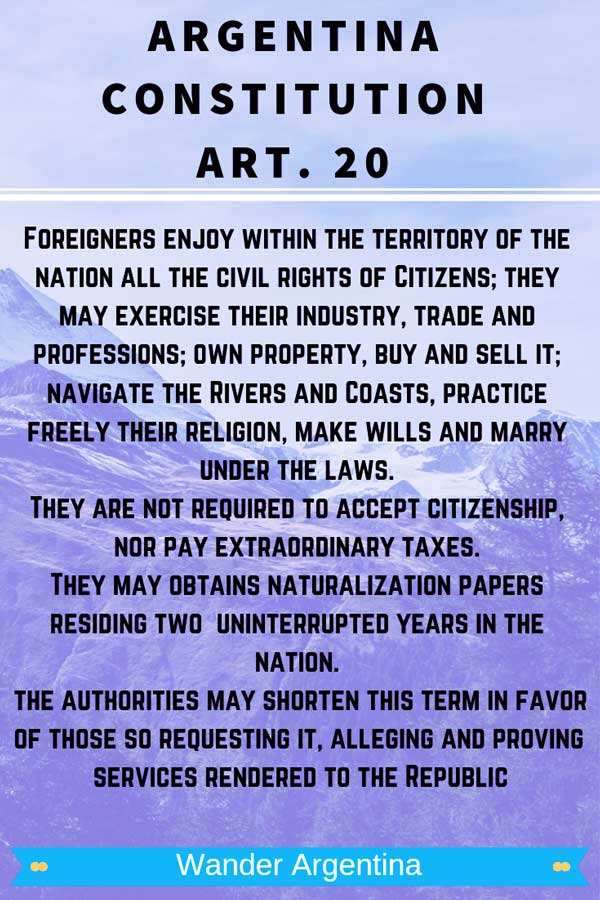
Another option is to apply directly for citizenship, which is permitted by article 20 of the Argentine constitution for anyone who has resided in the country for at least two years, speaks Spanish, does not have a criminal record and can prove ‘honest means of earning a living.’
Although this option has less restrictions and is quicker, the process is more expensive if you pay a lawyer and there is always the outside risk the application for citizenship will be declined.
• Can I survive living as a travel writer in Argentina?
Everyone wants to be a travel writer these day. Depending on how you look at it, it’s quite optimistic or completely unrealistic to think you can simply move to Argentina and start making a living as a travel writer if you don’t have prior experience. You can always try — you will certainly be in good company. Just make sure you have an adequate amount of money saved up before you move here. Many of the local English publications and websites (Wander-Argentina included) do have internship programs but you’ll usually need your own equipment and you won’t make any money.
If you have previous published clips you can definitely pitch articles to the ever-shrinking numbers of travel publications out there. Hopefully you are quite talented and persistent — there are a lot of people trying to do the same thing. For the few scribes in Argentina who write for high-paying glossy publications, life is good.
• Is it difficult to start a business in Argentina?
Those with an entrepreneurial vision will probably find that Argentina has a lot of room for new businesses that import good ideas and quality products and services. There is certainly demand for services that currently do not exist. Figuring out what kind of business would do well here is just a matter of living in the country a while and seeing what products or services are needed.
For example, a whole foods café and juice bar in the heart of San Telmo would be a good bet while opening a steakhouse or a bakery similar to those throughout the city would be a bit redundant.
A microbrew in a nice neighborhood might do very well — there are a growing number of microbrew beers available in the country, but there is a lot of demand and the few artisanal beers that do exist have limited distribution.
Love it or hate it, even Starbucks, which came into the country in 2007 seems to be doing well despite charging prices equivalent to what the average Argentine earns in one hour for a coffee drink (see this interview for more on that).
Why? The concept of serving specialized, quality coffee drinks in a ‘cozy atmosphere’ where one can sit down on a couch instead of a table to read the paper is completely new to Argentina.
Novelty alone isn’t self-sustaining though — a consistent level of quality will keep people coming back.
Similarly, creating much needed jobs while taking advantage of lower labor costs to provide services for overseas clients will put any business at an advantage. Finding quality employees is one of the most difficult challenges, but due to the current economic crisis there are a growing number of foreigners with abundant experience and a good work ethic in Buenos Aires looking for jobs.
Starting a business in Argentina will be a paperwork headache similar to getting residency. There are 15 paperwork procedures that need to be completed in order to start a business, for which you can hire someone to complete.
Once again the easiest way to go about it would be to hire a good lawyer to help you complete these steps. If that’s not an option you may want to consider whether you have enough capital and/or vigor to start a business in the first place. A good place to start may be to join local business-oriented meetup or ‘Expat’ groups to meet other people installed and running businesses in Argentina.
Once the paperwork is out of the way, many of the foreign business owners in Argentina seem quite happy with their businesses. The challenges for business owners aren’t over once everything is up and running though.
Among the ongoing problems — none of the unique to Argentina — are: finding and retaining good employees, enforcing contracts (the courts are very slow and not practical for minor disputes) robbery and possible shakedowns by corrupt police or inspectors.
To get a realistic idea of what you’re in for, it’s a good idea to talk at length to other business owners about their experiences.
Argentina is open for business, there is money to be made, there are plenty of people who want jobs — just be sure to get a very good handle on the lay of the land before you undertake the challenge.
For more information on living and working in Argentina, please see our sister site, Wander-Argentina.org.
Please note, due to the number of inquiries, we are not able to respond to personal requests for information.
If you have specific Argentina-related questions, consider booking a consultation with Wander Argentina’s founder and editor.

1 thought on “Living in Argentina”